

October 1 developments, plus Anthropic’s September 30 robot paper as a late discovery. Sources checked October 2, 2026, Eastern time.
A faster voice loop still needs manners
Microsoft AI launched MAI-Transcribe-2-Streaming, MAI-Voice-2.1 and a Flash voice variant on October 1. Microsoft says transcription detects 60 languages continuously and starts returning partial text just over 100 milliseconds after receiving audio. Voice supports 23 languages and 26 locales.
The models are available through Microsoft Foundry and the MAI Playground; additional voice channels include OpenRouter and Vercel, with LiveKit support coming later. Accuracy and latency comparisons are vendor claims. Test interruptions, corrections, language switches and background noise: fast words alone do not make a good conversation.
Suncatcher reaches orbit
Google confirmed its Planet-built Project Suncatcher prototype launched on SpaceX’s Transporter-18 mission October 1. Contact was established and Google says the satellite is operating as expected. Coming tests will examine TPU launch stress, radiation and thermal extremes.
That is a real milestone, but linked satellites providing scalable machine-learning infrastructure remain research. The launch does not establish an advantage over terrestrial data centers in cost, cooling, reliability, debris risk or networking. Keep “hardware in orbit” separate from “an orbital AI data center.”
Robots can do more than they can do cheaply
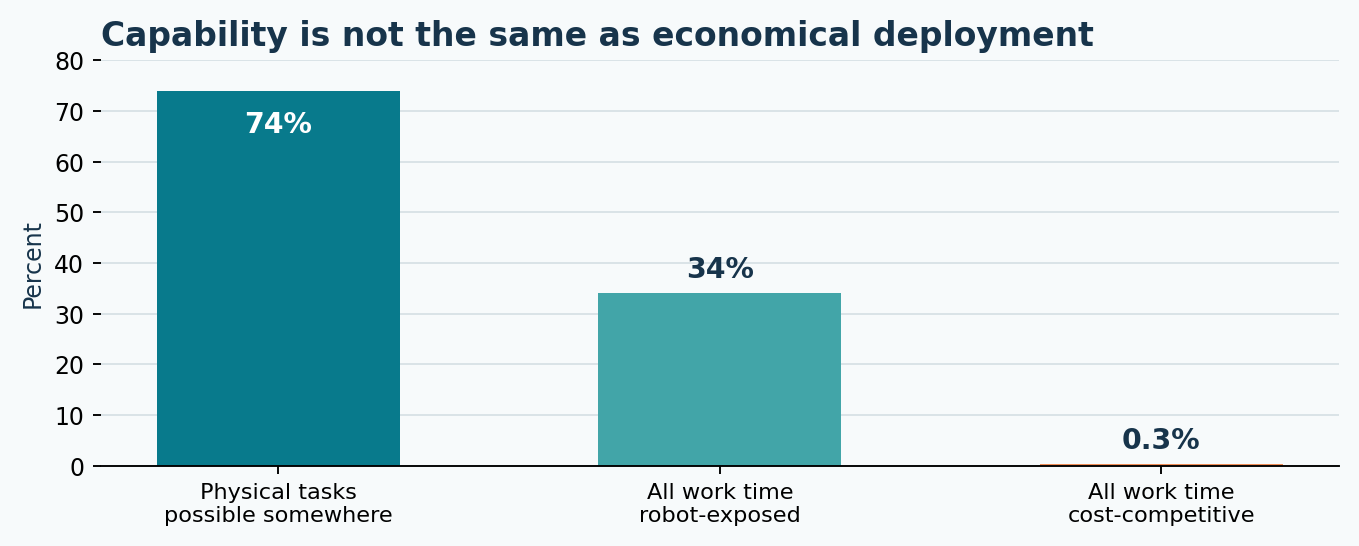
Anthropic’s September 30 research estimates robots can perform 74% of physical tasks in at least some environment, representing 34% of all work time. Yet it estimates robots are cost-competitive for only 0.3% of work today. The percentages use different denominators.
The index combines roughly 19,000 O*NET tasks, demonstrations, deployments and Claude-assisted judgments. Model-assisted time and cost estimates are not a census of real automation. A task on a controlled production line is not the same task in a home, street or hospital. The claims deserve replication.
Accountability moves through bills and courts
Senators Chris Murphy and Josh Hawley proposed the AI Agent Accountability Act October 1. It would target operators that knowingly run agents which recklessly cause hacking harm, and developers that fail to apply reasonable safeguards despite knowing, or having reason to know, of hacking capabilities. It is proposed legislation, not enacted law; actual exposure would depend on final text and case facts.
Separately, Judge Amit Mehta dismissed Chegg and Penske Media antitrust suits challenging Google’s AI Overviews. Reuters reports that the pleaded reciprocal-dealing theories failed. This does not settle every copyright, contract or policy question about AI summaries. Different legal questions need different evidence and claims.
Murphy: proposed bill · Reuters: Google ruling
AI expertise becomes the phishing bait
Proofpoint describes a China-aligned campaign, TA419, targeting U.S. think tanks, universities and legal organizations. Impersonated experts offered an invented AI advisory committee or purported Senate report; after a reply, shortened links led to fake Microsoft 365/OneDrive sign-in pages designed to capture credentials and session material.
Proofpoint does not publicly quantify successful compromises. Verify invitations through an independent channel and use origin-bound, phishing-resistant sign-in such as passkeys. A realistic cloud login reached through an unexpected link is not proof of legitimacy. This is social engineering around AI, not evidence that AI wrote the lure.
Three things to try with AI
Original proposals, not news or authorization to run tools or spend money. Time estimates are approximate; use existing access where possible.
Caption-to-Camera Relay
Ask AI to hide a public-domain photograph and extract five constraints: camera height, light direction, geometry, emotional temperature and one forbidden element. Shoot your own frame before seeing the source. Allow 45–90 minutes with chat and a camera. Get consent for identifiable subjects and remove location metadata before sharing.
Voice-Latency Metronome
Run 12 scripted exchanges: four interruptions, four language switches and four noisy-room phrases. Record response timing, correction success and whether the assistant talks over you. About 35 minutes with an existing voice assistant, stopwatch and spreadsheet. Avoid sensitive conversations or other people’s voices. Optional API tests may cost money; one trial is exploratory.
Invisible Automation Diary
Log ten algorithmic nudges in a day, such as routes, spam filters or photo enhancement. Ask AI to classify visibility, reversibility, evidence and the cost of error; extend it over seven days if useful. Allow ten minutes daily and 30 minutes to review. Keep names, locations, health and financial details out.